
Peanut in the Lung, Oxygen at 40%: Two Infants Narrowly Escape Death in Faridabad
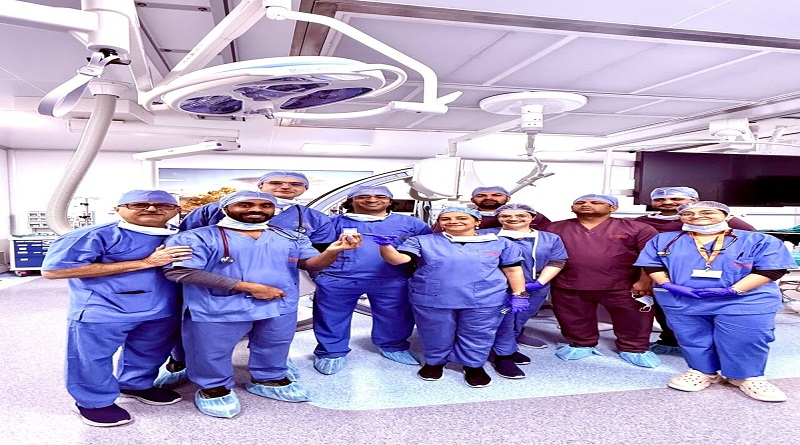
Routine feeding turns life-threatening as doctors battle the clock to save babies choking from within
Faridabad, 17 January 2026: What began as an ordinary winter day turned into a race against death for two families in Faridabad, when their infants accidentally inhaled food particles that silently blocked their lungs — pushing both children to the brink of fatal respiratory failure.
Within hours of each other on the day of Makar Sankranti, two babies — aged just one year and eight months — were rushed to Amrita Hospital, Faridabad in critical condition. Doctors say that in both cases, even a short delay could have ended in tragedy.
A Week of Breathlessness — Caused by a Single Peanut
The first child, aged one year and three months, had been suffering from persistent cough and breathing difficulty for nearly a week and was undergoing treatment at another hospital. His condition kept worsening. By the time he reached Amrita Hospital’s emergency department, his oxygen levels had dropped, and he was struggling to breathe.
After being stabilised overnight in the paediatric intensive care unit (PICU), doctors performed an emergency bronchoscopy the next morning. What they found was alarming — a peanut had completely blocked the child’s right main airway, cutting off air supply to the entire lung.
“Peanuts and similar food items swell when they enter the airway and come in contact with moisture,” said Dr. Sourabh Pahuja, Senior Consultant, Pulmonary Medicine.
“In this case, the lung was not receiving air at all. If removal had been delayed further, the child could have developed lung collapse, severe infection, or life-threatening oxygen failure.” The peanut was removed in time. Within hours, the child’s oxygen levels improved, and he was discharged the very next day.
“We kept thinking it was just a stubborn cough,” said the child’s father. “We had no idea something was stuck inside his lung. The doctors saved our child’s life.”
Oxygen Drops to 40% — Survival Hanging by a Thread
Just hours later, the hospital faced an even more frightening emergency. An eight-month-old baby was rushed in with oxygen saturation of just 40 percent — a level doctors describe as critically life-threatening.
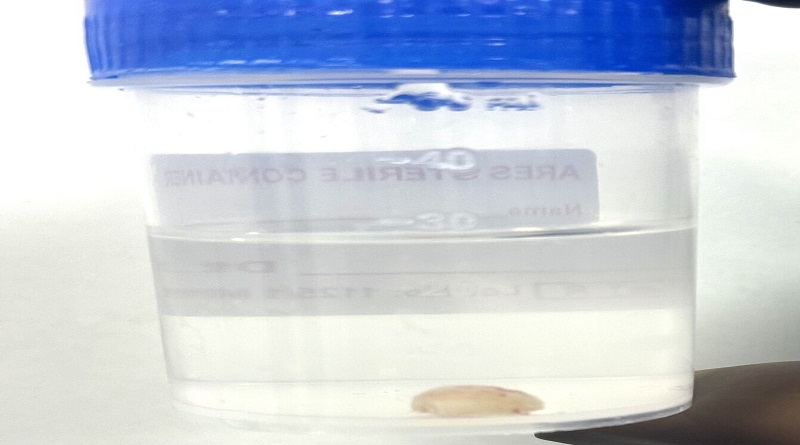
Medical records showed the baby had been ill for nearly 10 days and had been treated elsewhere. Scans indicated a foreign object lodged deep inside the left lung.
“There was no time to wait,” said Dr. Pahuja. “The baby was not maintaining oxygen levels. Even minutes mattered.”
The infant was taken straight to the operating theatre. The procedure was extremely challenging due to the tiny size of the baby’s airway and the dangerously low oxygen reserve. When standard instruments failed, the medical team deployed advanced freezing (cryotherapy) technology to safely attach to and extract the organic foreign body.
“The object was removed within minutes,” Dr. Pahuja said. “But because it had remained inside the airway for many days, it had already caused swelling and damage.”
The baby required two to three days of intensive monitoring before his breathing stabilised and was later discharged.
“We were told our baby might not survive the night,” said the child’s mother. “Hearing him breathe normally again felt like a miracle.”
A Coordinated Life-Saving Effort
Doctors emphasised that both rescues were possible only because of a highly coordinated, multi-disciplinary response involving specialists trained to manage paediatric airway emergencies.
The cases were jointly managed by Dr. Sourabh Pahuja, along with Dr. Maninder Singh Dhaliwal, Principal Consultant, PICU & Pediatric Respiratory Medicine, supported by a specialised paediatric anaesthesia team, critical care nurses, and respiratory therapists — all working in tandem under extreme time pressure.
“Managing foreign body aspiration in infants is among the most complex emergencies we face,” said Dr. Maninder Singh Dhaliwal. “These children arrive with minimal oxygen reserve. Every step — from anaesthesia to airway access — must be precise. There is absolutely no margin for error.”
Doctors Sound a Serious Warning
Doctors say such cases are more common than most parents realise — and often turn fatal because warning signs are missed or treatment is delayed.
“A sudden coughing fit during feeding is not something to ignore,” Dr. Pahuja warned.
“If coughing, wheezing, or breathing difficulty continues beyond a day, parents must seek immediate medical evaluation. Food may have entered the airway instead of the food pipe.”
Doctors also stressed that not all hospitals are equipped to handle such emergencies.
“Foreign body removal from infant airways requires specialised skills, paediatric anaesthesia support, and advanced equipment,” Dr. Pahuja said. “Losing precious time at under-equipped centres can cost a child’s life.”
A Message Every Parent Needs to Hear
Doctors strongly advise parents to:
- Never give infants small, hard foods like peanuts or cashews
- Always supervise children during meals
- Keep small objects out of children’s reach
Both infants in these cases were from Faridabad. Doctors say timely intervention saved their lives — but the outcome could easily have been very different.
“This is a preventable tragedy,” doctors stressed. “Because when a child cannot breathe, there is no second chance.”





Работа выездной службы построена так, чтобы для семьи всё было максимально понятно и предсказуемо. После звонка специалист не ограничивается общими фразами, а уточняет детали: сколько длится употребление, есть ли хронические болезни сердца, печени, почек, эндокринные нарушения, какие препараты и в каких дозах пациент уже получил, были ли в прошлом судороги, галлюцинации, тяжёлые реакции на лекарства. Это позволяет заранее оценить уровень риска и понять, подходит ли формат дома. По прибытии в Серпухове врач осматривает пациента, проверяет контакт и ориентировку, измеряет артериальное давление несколько раз, оценивает пульс, сатурацию, температуру, выраженность тремора, наличие болей, характер дыхания, степень обезвоживания. Далее формируется индивидуальная инфузионная схема: растворы для регидратации и коррекции электролитов, витамины группы B и магний для поддержки нервной системы, при необходимости — гепатопротекторы и мягкие антиоксидантные комплексы, противорвотные для контроля тошноты, щадящие анксиолитики для нормализации сна без грубой седации. Во время процедуры врач контролирует динамику, меняет скорость капельницы при необходимости, отслеживает реакцию на препараты и объясняет родным, какие изменения будут происходить по часам. По завершении визита пациент и родственники получают подробный план: режим, питьё, питание, чего нельзя, какие симптомы считаются тревожными, когда нужна повторная консультация или стационар. При выявлении опасных признаков вопрос о госпитализации поднимается честно и сразу, а не откладывается «до утра».
Изучить вопрос глубже – [url=https://narkolog-na-dom-serpuhov10.ru/]narkolog-na-dom-cena[/url]
Если намереваетесь поездку на Тенерифе, обязательно не пропустите Monkey Park Tenerife и бассейны Lago Martianez для незабываемого отдыха. Также важно узнать о расписании автобуса линии 343 (teneriffa bus 343 fahrplan), чтобы легко перемещаться по острову и изучить достопримечательности, например, пляж Тереситас и культовое драконовое дерево.
Для тех, кто интересуется культурой и событиями, призываю заглянуть в программу Carnevale Tenerife 2025, где можно прочувствовать традициями и весельем. Подробнее о Тенерифе, Канарских островах и их красотах можно почитать тут: [url=https://ispaniagid4.ru]гуадалест[/url] . А если вас манят другие города Испании у моря, как Барселона, Валенсия или Малага, то обязательно оцените пляжи и архитектуру, например, кафедральный собор Валенсии или парк Цитадель в Барселоне.
Выбор формата — это не вкусовщина, а баланс безопасности в конкретной клинической картине. Дом уместен, если контакт сохранён, рвота эпизодическая, давление и пульс без резких «качелей», тремор контролируемый, в квартире можно обеспечить тишину и присутствие взрослого, готового наблюдать первые 6–8 часов. Тогда выездная бригада работает на месте и выстраивает «мягкий» маршрут, где сон собирается без агрессивной седации, а инфузии идут с шаговой корректировкой темпа. Стационар предпочтителен при длительном эпизоде (3–5 суток и более), неукротимой рвоте, выраженной слабости, шаткости походки, признаках предделирия/делирия, судорожной готовности, а также у пожилых пациентов и при сочетанных диагнозах — ИБС, гипертония, диабет, хронические болезни печени/почек, неврология. Преимущество отделения — приборный мониторинг, лабораторные опции по показаниям, ночная команда и среда, где исключены лишние раздражители: это снижает «цену ошибки» и делает результат устойчивым, а не разовым «прояснением».
Узнать больше – [url=https://vyvod-iz-zapoya-ehlektrostal2-10.ru/]vyvod-iz-zapoya-na-domu[/url]
Have you ever thought about writing an ebook or guest authoring on other sites? I have a blog based on the same topics you discuss and would really like to have you share some stories/information. I know my visitors would appreciate your work. If you are even remotely interested, feel free to send me an e mail.