
IND vs NZ 5th T20: New Zealand Beat India by 7 Wickets, Ishan Kishan Breaks Suryakumar Yadav’s Record, Arshdeep Singh Creates World Record

New Zealand defeated India by 7 wickets in the fifth and final T20 International match at Hamilton. Although India suffered a defeat, the match turned out to be special for several Indian and New Zealand players, who achieved major individual milestones.
Indian wicketkeeper-batter Ishan Kishan created history by breaking former India captain Suryakumar Yadav’s record for the most T20 International runs scored by an Indian batter in a calendar year. Meanwhile, Indian fast bowler Arshdeep Singh achieved a remarkable milestone in powerplay bowling, becoming the leading wicket-taker in the first six overs of T20 Internationals.
The match also witnessed some exciting moments on the field. Ishan Kishan survived a spectacular boundary catch by Finn Allen, while Tilak Varma escaped dismissal after a brilliant catch was ruled out because of a no-ball. New Zealand captain Mitchell Santner also achieved a major career milestone, becoming the country’s most-capped T20 International player. Meanwhile, Glenn Phillips finished the five-match bilateral series with a record-breaking 341 runs.
Ishan Kishan Breaks Suryakumar Yadav’s Record
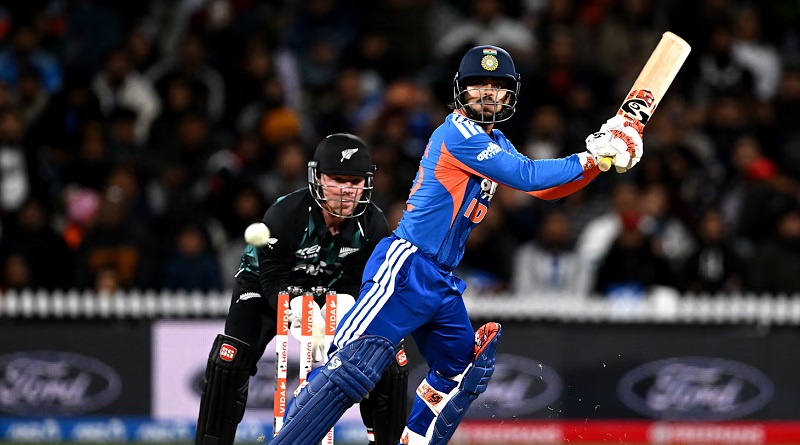
Ishan Kishan enjoyed a memorable outing in the fifth T20 International against New Zealand. The Indian batter played an explosive innings of 61 runs off just 32 deliveries, helping India strengthen its batting performance.
With this innings, Kishan took his total T20 International runs in 2026 to 1,220. He surpassed former India captain Suryakumar Yadav, who had scored 1,164 runs in T20 Internationals in 2022.
Kishan has now become the Indian batter with the most T20 International runs in a single calendar year.
This achievement highlights his consistency and aggressive approach in the shortest format. Scoring more than 1,200 runs in a calendar year requires exceptional batting skills, regular performances and the ability to adapt to different bowling attacks.
His impressive form has also strengthened his position as an important batter in India’s T20 setup.
Ishan Kishan Completes 2,000 T20I Runs in Just 1,345 Balls
Apart from breaking Suryakumar Yadav’s calendar-year record, Ishan Kishan achieved another significant milestone in the fifth T20 match.
He completed 2,000 runs in T20 International cricket after facing just 1,345 deliveries.
Kishan became the third-fastest Indian batter to reach the 2,000-run milestone in terms of balls faced.
Abhishek Sharma holds the top position on this list. He reached 2,000 T20 International runs in just 1,024 balls.
Kishan’s aggressive batting style has played a major role in helping him achieve this milestone. He is known for attacking bowlers from the beginning of an innings and scoring quickly during the powerplay.
His ability to accelerate the scoring rate makes him an important asset for the Indian team.
Arshdeep Singh Creates History with Powerplay Wickets
Indian left-arm fast bowler Arshdeep Singh achieved a remarkable bowling milestone in T20 International cricket.
He has taken 65 wickets during the powerplay overs, making him one of the most successful new-ball bowlers in the format.
Arshdeep reached the milestone of 65 powerplay wickets, equalling New Zealand fast-bowling legend Tim Southee’s tally. However, Arshdeep achieved the feat in fewer innings than Southee.
Among bowlers representing full-member nations, Arshdeep has reached the top position in terms of powerplay wickets.
The first six overs are extremely important in T20 cricket because teams look to score quickly while fielding restrictions are in place. Taking wickets during this period can put significant pressure on the opposition.
Arshdeep has consistently delivered impressive performances with the new ball. His ability to swing the ball, maintain accurate line and length, and produce breakthroughs makes him a valuable member of India’s bowling attack.
His latest achievement further strengthens his reputation as one of India’s leading T20 fast bowlers.
Mitchell Santner Becomes New Zealand’s Most-Capped T20I Player
New Zealand captain Mitchell Santner also achieved a major milestone during the fifth T20 International against India.
He became the most-capped T20 International player for New Zealand after featuring in his 143rd match.
Santner moved ahead of experienced New Zealand spinner Ish Sodhi, who has played 142 T20 International matches for the country.
Santner has been an important part of New Zealand cricket for several years. His economical left-arm spin, useful lower-order batting and leadership qualities have made him a key player across formats.
He has regularly contributed to New Zealand’s performances in international cricket.
Playing 143 T20 International matches is a significant achievement and reflects his consistency, fitness and importance to the national team.
Glenn Phillips Scores Record 341 Runs in the Bilateral T20I Series
New Zealand batter Glenn Phillips produced an outstanding performance throughout the five-match T20 International series against India.
He scored a total of 341 runs in the series, setting a new record for the most runs scored by a batter in a bilateral T20 International series.
Phillips broke the previous record held by England batter Phil Salt.
Salt had scored 331 runs during England’s five-match T20 International series against the West Indies in 2023.
Phillips went past that mark by scoring 341 runs against India.
His performances proved extremely important for New Zealand throughout the series. He consistently attacked Indian bowlers and played several valuable innings.
Phillips is known for his powerful hitting and ability to play shots all around the ground. His performances against both pace and spin bowling make him a dangerous batter in T20 cricket.
The 341-run achievement is another major milestone in his international career.
Finn Allen’s Boundary Catch Fails to Dismiss Ishan Kishan
One of the most interesting moments of the fifth T20 International occurred during the sixth over.
Ishan Kishan attempted a big shot towards the long-on boundary off Mitchell Santner’s bowling.
New Zealand fielder Finn Allen was positioned near the boundary. He displayed excellent athleticism by taking the catch and attempting to complete the dismissal.
Allen initially caught the ball, tossed it into the air and tried to complete the catch again. However, the third umpire reviewed the footage and noticed that Allen’s right foot had touched the ground beyond the boundary while he was in contact with the ball.
According to the cricket rules, a fielder cannot touch the ground outside the boundary while in contact with the ball during a catch.
As a result, the shot was declared a six, and Kishan survived the dismissal.
It was an unfortunate moment for New Zealand because Allen had almost completed a spectacular catch. However, the boundary rule ensured that India received six runs instead of losing a wicket.
Tilak Varma Gets a Lifeline After Nathan Smith’s No-Ball
Another dramatic moment occurred during Nathan Smith’s 14th over.
On the second delivery, Indian batter Tilak Varma attempted a shot but failed to keep it along the ground.
Finn Allen, positioned at backward point, dived brilliantly towards his right and completed an impressive catch.
New Zealand players celebrated the dismissal, but the umpire soon declared the delivery a no-ball.
The replay showed that Nathan Smith had overstepped the crease while delivering the ball.
As a result, Tilak Varma was declared not out and received another opportunity to continue his innings.
The no-ball also meant that India received a free hit on the next delivery.
The incident highlighted how important bowling discipline can be in T20 cricket. A small mistake by the bowler cost New Zealand a valuable wicket.
Abhishek Sharma Takes a Brilliant Diving Catch to Dismiss Daryl Mitchell
Indian opener Abhishek Sharma impressed everyone with his fielding during the fifth T20 International.
The incident took place during the ninth over bowled by Varun Chakravarthy.
On the third delivery, New Zealand batter Daryl Mitchell attempted to play an attacking shot against a full-length delivery.
However, the ball travelled towards long-off, where Abhishek Sharma was positioned.
Abhishek quickly moved forward and completed an excellent diving catch.
Mitchell had to return to the pavilion after scoring 29 runs off 16 deliveries.
His dismissal was important for India because he was looking comfortable at the crease and scoring at a good pace.
Abhishek’s effort demonstrated the importance of athletic fielding in modern T20 cricket. A spectacular catch can change the momentum of a match and provide a crucial breakthrough for the bowling side.
New Zealand Defeat India by 7 Wickets in the Fifth T20I
The fifth T20 International between India and New Zealand ended with a seven-wicket victory for the visitors.
Despite Ishan Kishan’s impressive 61-run innings and several individual milestones, India could not prevent New Zealand from securing victory.
New Zealand’s batters delivered a strong performance while chasing the target and ensured that their team finished the match successfully.
For India, the match was a mixture of individual achievements and disappointment. Kishan and Arshdeep created significant records, while Abhishek Sharma also made an impact with his fielding.
For New Zealand, Glenn Phillips and Mitchell Santner were among the major performers in terms of individual milestones.
India’s Individual Records Make the Match Memorable
Although India lost the fifth T20 International by seven wickets, the match produced several memorable achievements.
Ishan Kishan became the highest Indian run-scorer in T20 Internationals in a calendar year with 1,220 runs. He also completed 2,000 T20 International runs after facing just 1,345 balls.
Arshdeep Singh reached 65 powerplay wickets, matching Tim Southee’s overall tally while achieving the milestone in fewer innings.
Meanwhile, New Zealand celebrated two major individual achievements. Mitchell Santner became the country’s most-capped T20 International player with 143 appearances, while Glenn Phillips established a new bilateral T20I series record with 341 runs.
The match also featured dramatic fielding moments, an important no-ball decision and a spectacular diving catch.
Overall, the fifth T20 International at Hamilton will be remembered for its outstanding individual performances, exciting moments and record-breaking achievements. Although New Zealand finished the match with a seven-wicket victory, Ishan Kishan and Arshdeep Singh gave Indian fans plenty of reasons to celebrate.
Frequently Asked Questions
How many T20 International runs did Ishan Kishan score in 2026?
Ishan Kishan scored 1,220 T20 International runs in 2026, surpassing Suryakumar Yadav’s previous Indian record of 1,164 runs in 2022.
How many powerplay wickets has Arshdeep Singh taken in T20 Internationals?
Arshdeep Singh has taken 65 wickets during the powerplay in T20 International cricket, matching Tim Southee’s tally.
How many runs did Glenn Phillips score against India in the five-match T20I series?
Glenn Phillips scored 341 runs in the five-match bilateral T20 International series against India, breaking Phil Salt’s previous record of 331 runs.
Who has played the most T20 International matches for New Zealand?
Mitchell Santner became New Zealand’s most-capped T20 International player with 143 appearances, moving ahead of Ish Sodhi, who has played 142 matches.
Why was Tilak Varma not given out despite Finn Allen taking the catch?
Tilak Varma survived because Nathan Smith had overstepped the crease while delivering the ball. The umpire declared it a no-ball, which meant Tilak remained not out and received a free hit on the next delivery.
How did Ishan Kishan survive Finn Allen’s boundary catch?
Finn Allen’s right foot touched the ground beyond the boundary while he was in contact with the ball. Under cricket rules, the shot was therefore declared a six instead of a dismissal.


